
Khari Baoli Desi Ghee: Wholesale Fats Lack Traceability
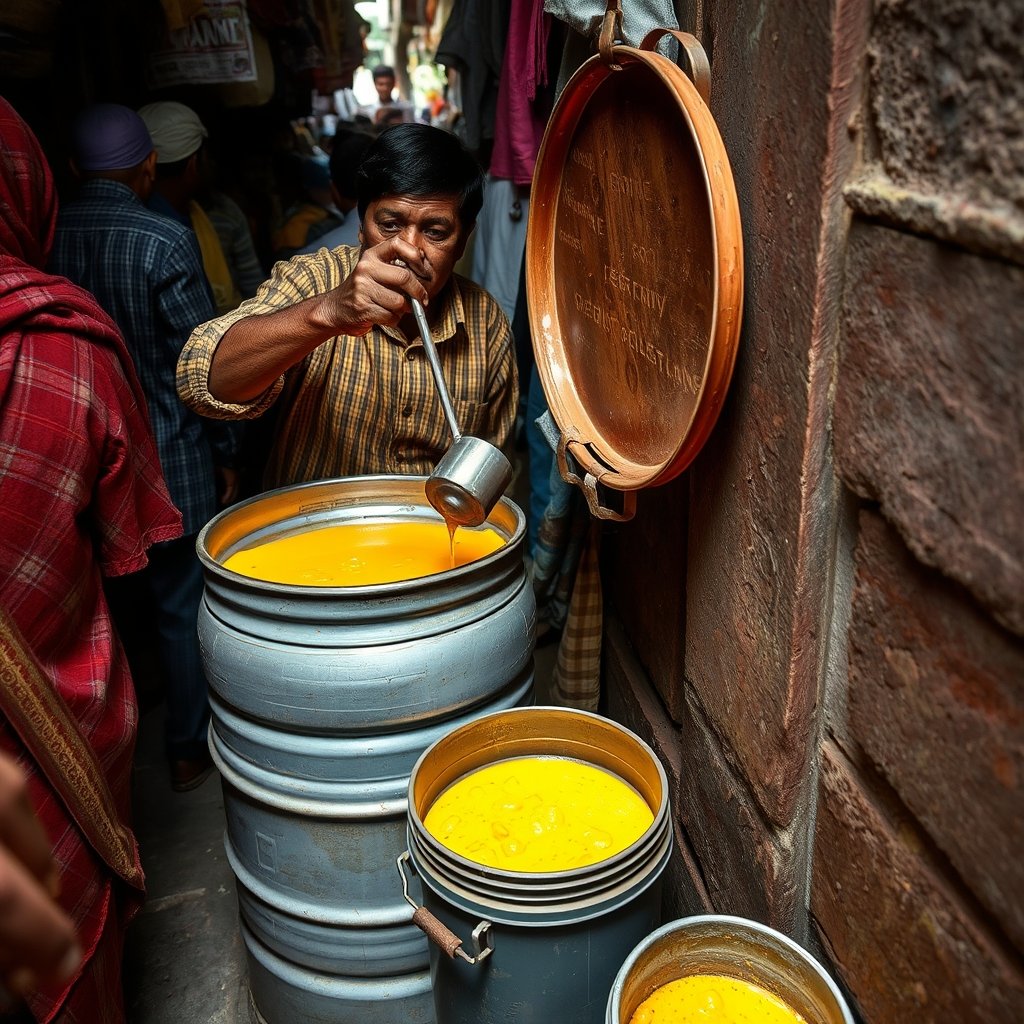
Khari Baoli in Old Delhi offers bulk pricing for commercial cooking fats, but buying desi ghee there provides wholesale fat batches based on moisture standardisation rather than verifiable farm provenance or breed-specific bilona churn methods. Tucked behind the Fatehpuri Masjid, the narrow lanes of Khari Baoli have anchored northern India’s fat and spice trade since the seventeenth century. While halwais, sweet shops, and commercial caterers rely on these historic wholesale traders for large tin orders, the market mechanism prioritizes volume and fat consistency over small-batch artisan crafting.
How Does the Desi Ghee Trade Work in Khari Baoli?
The ghee trade in Khari Baoli operates through a vast network of commission agents, brokers, and wholesale traders who aggregate cream and butterfat from regional dairy hubs. Bulk merchants receive large consignments of white butter or cream-extracted fat in tin canisters from regional processing units across Punjab, Haryana, and western Uttar Pradesh. These fats are graded primarily by moisture content, free fatty acid levels, and shelf stability rather than animal breed or pasture access. Because sweet makers and commercial kitchens require predictable melting points for large-scale frying, traders blend batches to maintain uniform kitchen performance throughout the year.
Why Is Farm Provenance Difficult to Trace in Wholesale Markets?
Farm provenance is difficult to trace in wholesale spice and fat markets because the supply chain aggregates milk from hundreds of small village collection centres into regional chilling plants before processing. When milk from mixed herds—comprising buffaloes, crossbred cows, and indigenous cattle—is pooled together, distinct breed characteristics such as A2 beta-casein proteins cannot be isolated. By the time clarified fat reaches the tin containers stacked inside Gadodia Market or Naya Baans, it represents an aggregated commodity. For a home cook seeking ghee from a single indigenous breed like the Gir cow, wholesale commodity chains lack the origin segregation necessary to verify the source.
Our cows are not use and throw

A cow that stops giving milk is still our cow. She stays on the farm, with the same feed, the same shed and the same medical care she had when she was milking. We do not sell her on and we do not let her go. That is the whole basis of the ghee we make — you cannot ask an animal for her milk and then abandon her for it.
Our mission goes further than our own herd. There are cows on the street who are injured every day, who eat plastic, who cry through the night with nobody coming. We want to take them in. The plan is a chain of Organic Farmz gaushalas in several places, so that help is not one shed in one city but something a hurt animal can actually reach.
This takes more than we can carry alone — land, fodder, vets, hands. Come and join our initiative. Anything you give goes to feed, treat and shelter these cows.

Scan with any UPI app
Bank transfer
- Account name Organic Farmz
- Bank Indian Bank
- Account number 8133177322
- IFSC code IDIB000K555
- UPI ID organicfarmz@ptaxis
On a phone, the button above opens your UPI app directly — a QR on the screen you are reading cannot be scanned by that same screen. On a laptop, scan the code with your phone instead.
How Does Khari Baoli Ghee Compare to Direct Bilona Ghee?
Wholesale ghee traded in Old Delhi differs fundamentally from direct farm-sourced bilona ghee in its raw material processing, churn method, and batch scale. Commercial market ghee relies on mechanical cream separators to extract fat directly from raw milk, whereas traditional bilona ghee requires setting whole milk into curd before churning. The table below illustrates the key operational differences between wholesale market ghee and direct-sourced A2 Gir cow bilona ghee:
| Parameter | Wholesale Khari Baoli Ghee | Direct A2 Gir Cow Bilona Ghee |
|---|---|---|
| Fat Extraction Source | Direct industrial cream separation | Whole milk cultured into curd |
| Supply Chain Structure | Aggregated multi-dairy pooling | Single-origin farm sourcing |
| Breed Isolation | Mixed herd (buffalo and crossbred) | Purebred A2 Gir cows |
| Churning Technique | High-speed industrial centrifuges | Two-way bi-directional wooden bilona |
| Batch Size & Traceability | Large commercial tins (15kg+) | Small glass jar batches with farm logs |
What Should You Ask Before Buying Ghee in Old Delhi?
Before purchasing ghee in Old Delhi, you should ask the trader whether the fat comes from a single dairy origin, whether it was churned from cultured curd or sweet cream, and if batch test reports confirm the cow breed. Most traditional shopkeepers in Khari Baoli will openly clarify that their bulk tins contain commercial cream-separated ghee designed for high-heat sweet preparation rather than daily home table use. If a vendor claims to sell authentic bilona ghee at commodity wholesale prices, ask to inspect the production logs and FSSAI lab documentation, as true hand-churned extraction from Gir cow milk yields limited volumes that rarely flow into bulk commodity trading houses.
Why Does Traditional Bilona Method Require Traceable Sourcing?
The traditional bilona method requires traceable sourcing because every stage—from culturing whole milk overnight to slow-churning the curd—relies on the natural butterfat structure of healthy, pasture-grazed indigenous cows. In Ayurvedic culinary traditions, ghee prepared through the bilona process serves as a gentle carrier for spices and everyday meals, depending on slow hand-clarification to preserve natural grain and subtle nutty aroma. Sourcing directly from dedicated Gir cow dairies ensures that the ghee retains its natural golden tint and granular body without needing artificial coloring, synthetic aromas, or industrial temperature manipulation.
Taste the difference
Small-batch A2 Gir cow ghee, hand-churned to order and delivered across India. Read how we make it if you want the detail first.
Order a jarKeep reading
-
 Branded or Local Ghee: What You Trade Either Way
Branded ghee offers standardized consistency and recourse, while local ghee delivers freshness and…
-
 How to Buy Real Desi Ghee in Delhi: Spot the False Claims
Buy real desi ghee in Delhi by verifying the bilona method and breed-specific milk rather than accepting…
-
 Desi Ghee in Delhi: 5 Options from Kirana to Bilona
Delhi households can buy desi ghee from local kiranas, neighbourhood dairies, wholesale mandis, online apps…
