
Ghee vs Vanaspati: Why They Are Not the Same Thing
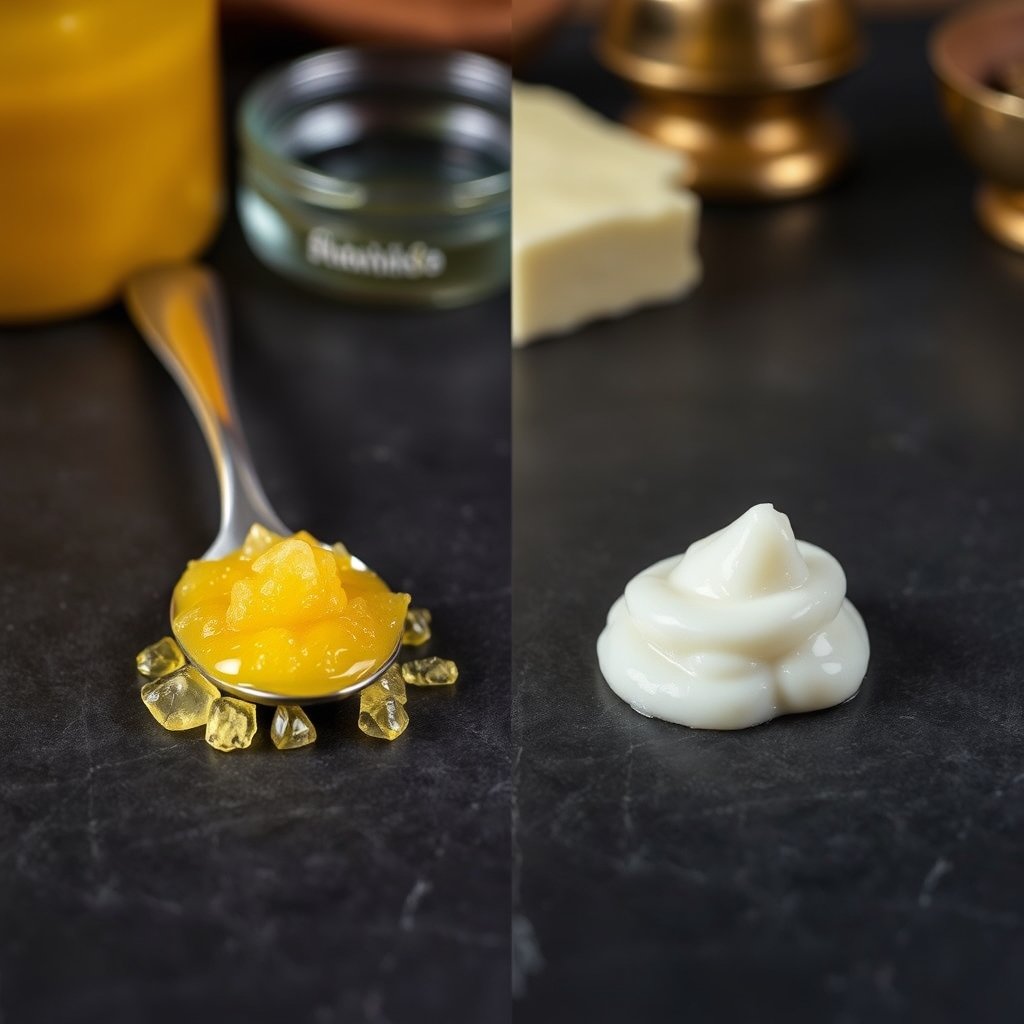
Ghee is a natural dairy fat obtained by clarifying milk butter or curd-derived butter, while vanaspati is an industrially processed vegetable oil that undergoes hydrogenation to become solid at room temperature.
Though both ingredients sit in tins or glass jars on Indian kitchen counters and share a superficially similar granular appearance, their origin, chemical nature, and culinary behavior belong to completely different categories. Understanding how they differ helps home cooks make intentional choices for daily meals, traditional sweets, and festive cooking.
What Is the Difference Between Ghee and Vanaspati?
The single biggest distinction between ghee and vanaspati lies in their raw source material. Pure cow ghee comes entirely from dairy milk. In traditional Indian households and smaller farm setups, cultured curd made from whole milk—such as milk from indigenous A2 Gir cows—is churned using a two-way wooden churn (bilona) to separate fresh butter (makkhan). This butter is then gently heated in a heavy vessel until the water evaporates and milk solids settle at the bottom, leaving behind clear, aromatic golden fat.
Vanaspati, on the other hand, contains no dairy fat whatsoever. It is produced by taking refined vegetable oils—most commonly palm oil, rice bran oil, or soybean oil—and subjecting them to chemical hydrogenation. In this industrial process, hydrogen gas is passed through liquid oil under high pressure and temperature in the presence of a metal catalyst like nickel. This reaction alters the liquid fat molecules into saturated forms, turning fluid oil into a semi-solid fat that resembles clarified butter.
How Do Preparation Methods Compare?
The journey from farm to vessel reflects two entirely different culinary philosophies. Traditional bilona ghee depends on patience, microbiology, and gentle heat control, whereas vanaspati relies on industrial refining and synthetic alteration.
When making A2 Gir cow ghee via the bilona method, the process begins with boiling fresh milk, allowing it to cool, and introducing a natural starter culture to form curd overnight. This fermentation step breaks down lactose and alters the fat structure before churning. The resulting butter is melted over slow flame, developing a natural sweet-nutty aroma and a signature coarse, grain-like texture (danedar) as it cools slowly in room temperature conditions.
To make vanaspati, raw plant oils undergo degumming, neutralizing, bleaching, and deodorization to remove naturally occurring colors and scents. After hydrogenation solidifies the oil, manufacturers often blend in artificial colorings, synthetic flavor compounds, and added vitamins to replicate the yellow shade, aroma, and nutrient profile associated with natural cow ghee.
How Do Ghee and Vanaspati Compare Side by Side?
To see how these two cooking fats differ across fundamental parameters, consider the overview below:
| Property | Traditional Pure Ghee (A2 Bilona) | Vanaspati (Hydrogenated Fat) |
|---|---|---|
| Source Material | Whole cow milk / cultured curd butter | Refined vegetable oils (e.g., palm, soy) |
| Processing Method | Natural curd fermentation, wooden churn, gentle simmering | Chemical hydrogenation under high heat and pressure |
| Melting Behavior | Melts quickly near body temperature (~32°C–35°C) | Higher melting point; leaves a noticeable coating on the palate |
| Aroma & Taste | Naturally nutty, rich dairy aroma from milk solids | Synthetic or added butter flavorings |
| Traditional Role | Central to Ayurvedic cooking, daily tadka, and festival sweets | Affordable commercial substitute for mass-scale frying |
How Do Ghee and Vanaspati Perform in Indian Cooking?
In everyday Indian cooking, fat acts as a vehicle for spices, heat distribution, and texture. Ghee and vanaspati handle heat and flavor release in distinct ways.
When you bloom whole spices like cumin, mustard seeds, or dried red chillies for a tadka, pure A2 ghee carries the volatile essential oils of the spices cleanly. Because ghee has a high smoke point (around 250°C) and melts completely at skin temperature, it creates a light, silky mouthfeel. In traditional sweets like besan laddoo or halwa, slow-roasted grains absorb warm ghee without leaving a heavy, sticky coating on the roof of the mouth.
Vanaspati was introduced commercially in the early 20th century as a lower-cost alternative to dairy fat for large-scale sweet shops and commercial bakeries. While it handles deep-frying well due to its high stability, its higher melting temperature means it can coat the tongue with a wax-like film when eaten in dishes served at room temperature or slightly chilled. Moreover, vanaspati lacks the natural complex aroma that develops when curd butter simmers over an open flame.
What Does Ayurveda Say About Real Ghee Versus Industrial Fats?
In traditional Ayurvedic literature, pure cow ghee—referred to as ghrita—holds a revered place among culinary ingredients. It is classified as a balancing food (*sattvic*) that nourishes digestive fire (*agni*) and serves as a natural vehicle (*anupana*) for herbs and spices. Ayurvedic texts specifically emphasize ghee prepared from cultured curd, noting that the fermentation process enhances its digestive compatibility and energetic properties.
Hydrogenated fats like vanaspati do not exist in classical Ayurvedic texts, as chemical hydrogenation is a modern factory innovation. From an Ayurvedic perspective, highly processed, re-engineered fats are considered difficult for the body to digest smoothly because they lack the natural intelligence and vitality found in fresh, unadulterated farm produce.
How Can You Identify Pure Ghee from Vanaspati at Home?
If you wish to check the qualities of the fat in your kitchen, a few simple observations can help:
First, observe the melting behavior. Rub a tiny dab of fat between your fingertips. Pure bilona cow ghee melts almost instantly from the warmth of your hands, feeling smooth and non-sticky. Vanaspati requires more heat to melt completely and leaves a heavier, grease-like residue on the skin.
Second, examine the aroma and grain. Pure A2 Gir cow ghee exhibits an understated, warm dairy scent that deepens when heated gently in a pan. Its grain forms naturally in varied sizes depending on ambient seasonal temperatures. Vanaspati often presents an overly uniform texture and a sharp, artificial butter scent that fades quickly when exposed to sustained heat.
At Organic Farmz, we preserve the traditional bilona approach—churning real curd made from A2 Gir cow milk in small batches—so that every jar offers the genuine taste, aroma, and warmth that Indian homes have relied upon for generations.