
Ghee Two Layers Separated: Temperature Softens Fat

A jar of ghee separates into a liquid upper layer and a solid lower layer when room temperature fluctuates, causing fatty acids with lower melting points to liquefy while higher-melting fats remain semi-solid at the bottom. This physical change is completely natural in pure cow ghee and does not indicate spoilage or poor quality.
Why does ghee separate into liquid and solid layers?
Ghee is not a single uniform chemical compound; it is a complex mixture of different triglycerides, each with its own melting point. The softer fatty acids in milk fat begin to turn liquid around 26°C to 28°C, while the harder, longer-chain fatty acids remain firm up to 36°C or 40°C. In an Indian kitchen where daytime ambient temperatures shift between morning cool and afternoon heat, the softer portion melts and floats to the top of the jar. Meanwhile, the denser, un-melted fat crystals sink to the floor of the glass container, creating a distinct two-layered appearance.
Does two-layer separation mean the ghee is spoiled?
Two-layer separation caused by temperature shifts does not mean the ghee is spoiled or unsafe to eat. Pure ghee contains virtually no moisture—less than 0.2 percent—which prevents bacterial growth even when parts of the jar liquefy. Spoilage in ghee is driven by moisture contamination or exposure to dirty spoons, which leads to a sour aroma or mould growth, not by simple physical separation. If your jar smells sweet, nutty, and clean, liquid fat resting above a dense solid layer is simply fat responding to room temperature.
How does the traditional bilona process influence ghee texture?
The traditional bilona method creates a naturally diverse crystal structure in fat because milk is cultured into curd before being churned into butter and slowly clarified over a low flame. This slow cooking allows large, distinct fat grains (danas) to form during gradual cooling. Because these bilona fat grains are unhomogenised and unrefined, they react dynamically to heat. Industrial ghee that undergoes rapid cooling or chemical stabilization often maintains a uniform, pasty look, whereas artisanal bilona ghee naturally forms grains that may separate into liquid and solid phases as ambient weather changes.
Our cows are not use and throw
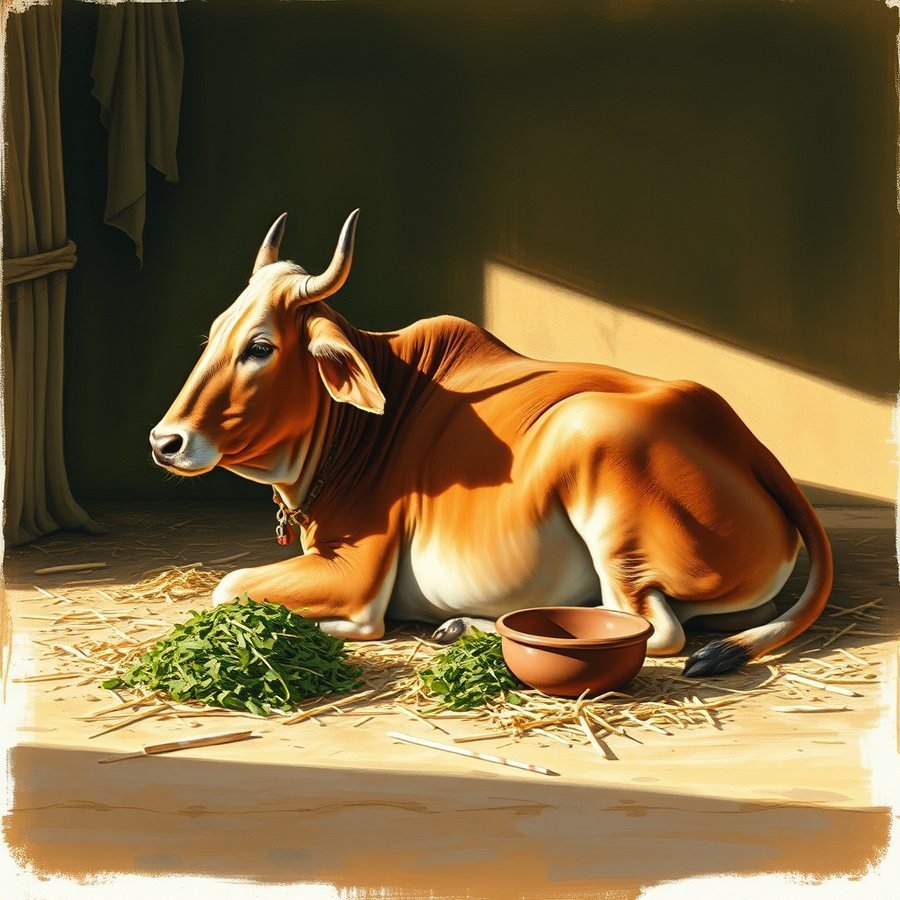
A cow that stops giving milk is still our cow. She stays on the farm, with the same feed, the same shed and the same medical care she had when she was milking. We do not sell her on and we do not let her go. That is the whole basis of the ghee we make — you cannot ask an animal for her milk and then abandon her for it.
Our mission goes further than our own herd. There are cows on the street who are injured every day, who eat plastic, who cry through the night with nobody coming. We want to take them in. The plan is a chain of Organic Farmz gaushalas in several places, so that help is not one shed in one city but something a hurt animal can actually reach.
This takes more than we can carry alone — land, fodder, vets, hands. Come and join our initiative. Anything you give goes to feed, treat and shelter these cows.

Scan with any UPI app
Bank transfer
- Account name Organic Farmz
- Bank Indian Bank
- Account number 8133177322
- IFSC code IDIB000K555
- UPI ID organicfarmz@ptaxis
On a phone, the button above opens your UPI app directly — a QR on the screen you are reading cannot be scanned by that same screen. On a laptop, scan the code with your phone instead.
How can you distinguish natural fat separation from adulteration?
Natural separation responds predictably to heat and cold, whereas separation caused by added starches, water, or foreign oils behaves differently under inspection. When pure ghee melts, the liquid layer remains clear, golden, and translucent without forming cloudy milky pools or rubbery residue at the base.
| Observation Feature | Natural Thermal Separation | Moisture or Adulteration Indicator |
|---|---|---|
| Top Layer Appearance | Clear, golden translucent oil | Cloudy liquid, foam, or watery beads |
| Bottom Layer Texture | Granular, soft fat crystals | Sticky gel, chalky mass, or tough rubbery sediment |
| Aroma upon Opening | Rich, nutty, roasted milk aroma | Sour, cardboard-like, or metallic odour |
| Behavior when Warm | Melts fully into uniform clear liquid | Leaves white streaks, curdles, or leaves watery liquid |
How do you restore a smooth, grainy texture to separated ghee?
You can restore a uniform granular texture to separated ghee by melting the entire jar gently and allowing it to cool down slowly in a quiet spot. Place the sealed glass jar in a bowl of warm water (around 50°C) until the contents turn entirely liquid. Once fully melted, stir the fat gently with a clean, dry spoon, then move the jar to a cool pantry or room away from direct sunlight. Allowing the melted fat to cool gradually over several hours encourages the fat crystals to rebuild into a consistent, grainy texture throughout the jar.
Taste the difference
Small-batch A2 Gir cow ghee, hand-churned to order and delivered across India. Read how we make it if you want the detail first.
Order a jarKeep reading
-
 Melting Ghee in Summer: It Is Perfectly Safe to Use
Liquid ghee in summer is completely safe to use because physical melting does not alter its nutritional…
-
 Storing Ghee in Delhi Heat: Keep Jars Dry in Shade
Ghee turns completely liquid in Delhi heat above 35°C, which is normal. Keep the glass jar in a dark, dry…
-
 Ghee Melted in Transit: No, Your Jar Is Not Ruined
Melted ghee is safe to consume and retains its quality; the liquid state is a natural reaction to heat…
