
Does Grainy Ghee Mean It Is Pure?
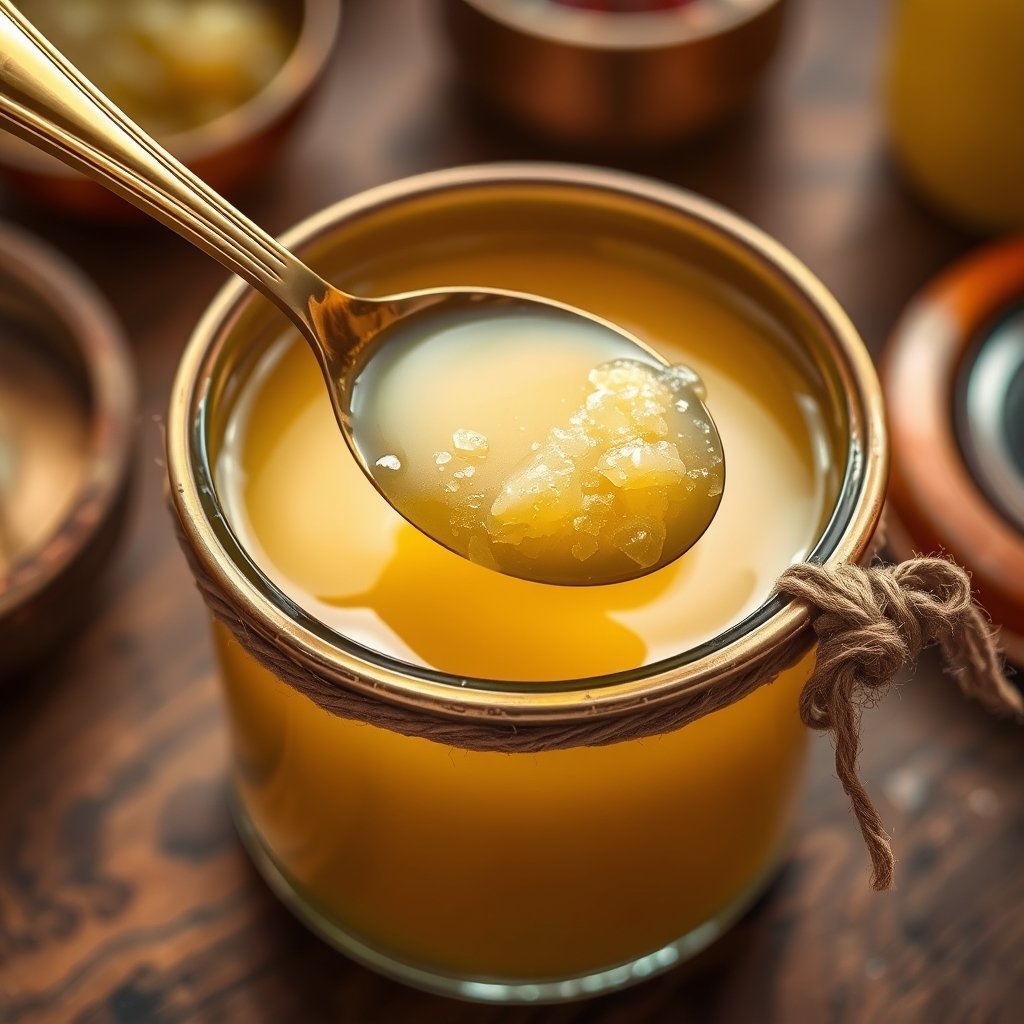
A grainy texture does not automatically mean ghee is pure, because graininess depends primarily on how fat molecules cool and crystallize rather than purity alone. In Indian homes, a jar of danedar, or grainy, ghee is often treasured as a mark of rich quality and traditional preparation. When melted ghee is allowed to cool slowly at room temperature, higher-melting fatty acids solidify into tiny grains first, suspended within lower-melting liquid fats. However, because commercial processing can manipulate cooling cycles or mix hydrogenated oils to replicate this granular structure, relying entirely on visual grains to determine purity can be deceiving.
Why Does Ghee Become Grainy in the First Place?
Ghee is composed of a natural spectrum of saturated and unsaturated fatty acids, each turning from liquid to solid at slightly different temperatures. Saturated fats like palmitic and stearic acids solidify at warmer room temperatures, while unsaturated fats remain liquid longer. When warm, freshly clarified ghee is poured into a jar and left undisturbed on a kitchen counter, the higher-melting fats begin to cluster together first. These clusters form solid nuclei—the distinct grains—while the liquid portion settles around them. If warm ghee is chilled rapidly in a refrigerator, the fats solidify instantly into a smooth, waxy block without forming grains. Conversely, slow cooling in ambient indoor warmth gives the fats time to organize into a classic, scoopable granular texture.
Can Adulterated or Processed Ghee Also Be Grainy?
Yes, adulterated fats and mass-produced factory ghee can easily look grainy. Industrial manufacturers often use controlled cooling chambers with precise temperature adjustments to force uniform crystallization in refined butter fats or oil blends. Furthermore, adulterants like vanaspati, which is partially hydrogenated vegetable oil, naturally form coarse, stiff grains that closely mimic the appearance of pure cow ghee. Low-grade fats can also be blended with palm oils or specific additives designed to produce a granular mouthfeel. Because visual graininess simply reflects the temperature history and fat cooling rate, a grainy jar alone does not prove that the product came from pure unadulterated milk.
How Does the Bilona Method Create Natural Danedar Ghee?
The traditional bilona method naturally develops a soft, aromatic grain structure without mechanical thermal tricks. In this process, fresh milk from A2 Gir cows is cultured into curd, which is then gently churned with a wooden bilona to yield fresh butter (makkhan). This curd-churned butter is simmered slowly over a mild flame in traditional brass or iron vessels. As the water content cooks off and milk solids brown at the bottom, clean golden fat separates. When filtered and allowed to rest undisturbed at room temperature, the diverse fatty acids from cultured A2 milk naturally bind into soft, uneven grains floating in rich fat.
How Does Natural Cooling Compare to Forced Industrial Cooling?
Understanding the difference between ambient room-temperature cooling and industrial thermal cooling explains why grain consistency varies across different types of ghee.
| Factor | Traditional Bilona Slow Cooling | Industrial Rapid / Forced Cooling |
|---|---|---|
| Cooling Process | Gradual cooling over hours at ambient room temperature | Forced chilling using cold water jackets or cooling tunnels |
| Grain Appearance | Soft, uneven, natural grains suspended in semi-liquid fat | Uniform, micro-crystallized, or forced synthetic graining |
| Texture Consistency | Changes naturally with room temperature and shifting seasons | Rigidly standardized across batches using mechanical controls |
| Aroma Trapped in Grains | Deep, nutty aroma released as grains melt on warm food | Milder or artificially supplemented scent upon melting |
How Can You Assess Ghee Quality Beyond Textural Grains?
Because texture alone is not a complete proof of purity, judging ghee requires using your other senses in the kitchen. Start with aroma: when a spoon of pure A2 Gir cow ghee melts over hot rotis, warm khichdi, or a sizzling tadka pan, it should release a warm, nutty, cooked-milk fragrance. Next, test how it melts on the skin. Pure ghee has a melting point close to human body temperature, meaning a small dab rubbed on your palm should soften smoothly without leaving a greasy, heavy, or wax-like residue. Finally, watch for natural seasonal shifts. Unprocessed bilona ghee stored in a home pantry naturally softens in warm summer months and firms up during winter cold. A jar that stays completely rigid or unnaturally identical across every season often points to chemical stabilizers or heavy processing.