
What Does "Hand-Churned" Actually Mean on a Ghee Label?

On a ghee label, hand-churned means that the butter used to make the ghee was extracted by churning cultured curd using a traditional wooden churner (bilona) operated manually or with a low-speed mechanical rig, rather than through high-speed industrial cream separation.
How Is Hand-Churned Ghee Prepared Step by Step?
The journey of hand-churned ghee begins long before any heating takes place. Fresh, whole milk from A2 Gir cows is gently boiled and cooled to ambient temperature. A small amount of previous-day curd starter is stirred in, allowing the milk to ferment overnight into thick, whole curd. Early the next morning, this curd is churned using a wooden bilona wrapped with a cord. Moving the bilona in clockwise and counter-clockwise directions coaxes the fat molecules together until soft mounds of makkhan gather at the surface. This butter is skimmed off by hand, rinsed, and slowly clarified over a gentle flame.
Why Does the Churning Method Matter for Aroma and Texture?
High-speed industrial separators spin raw milk at thousands of revolutions per minute to fling cream away from skim milk. While fast, this mechanical friction generates heat and breaks down natural aromatic compounds. In contrast, gentle hand-churning keeps the milk fat cool and intact. Fermenting whole milk into curd first allows lactic acid bacteria to create warm, buttery notes that carry over into the finished ghee. The gentle agitation also encourages uniform crystal formation, giving the final product its characteristic grainy texture (daana).
Our cows are not use and throw

A cow that stops giving milk is still our cow. She stays on the farm, with the same feed, the same shed and the same medical care she had when she was milking. We do not sell her on and we do not let her go. That is the whole basis of the ghee we make — you cannot ask an animal for her milk and then abandon her for it.
Our mission goes further than our own herd. There are cows on the street who are injured every day, who eat plastic, who cry through the night with nobody coming. We want to take them in. The plan is a chain of Organic Farmz gaushalas in several places, so that help is not one shed in one city but something a hurt animal can actually reach.
This takes more than we can carry alone — land, fodder, vets, hands. Come and join our initiative. Anything you give goes to feed, treat and shelter these cows.

Scan with any UPI app
Bank transfer
- Account name Organic Farmz
- Bank Indian Bank
- Account number 8133177322
- IFSC code IDIB000K555
- UPI ID organicfarmz@ptaxis
On a phone, the button above opens your UPI app directly — a QR on the screen you are reading cannot be scanned by that same screen. On a laptop, scan the code with your phone instead.
How Does Hand-Churned Ghee Compare to Factory-Churned Ghee?
Understanding the distinction between these two processes helps explain why genuine hand-churned ghee looks, smells, and performs differently in the kitchen.
| Feature | Hand-Churned Bilona Ghee | Factory Machine Ghee |
|---|---|---|
| Starting Material | Whole cultured curd | Separated raw cream (malai) |
| Fat Extraction | Gentle wooden churner motion | High-speed industrial centrifuge |
| Temperature during Extraction | Cool, room-temperature fermentation | Heat generated by rapid friction |
| Texture | Naturally granular and crystalline | Smooth, greasy, or uniform paste |
| Aroma Profile | Warm, nutty, pleasantly lactic | Mild, flat, or heavily toasted |
How Can You Identify Genuine Hand-Churned Ghee in Your Kitchen?
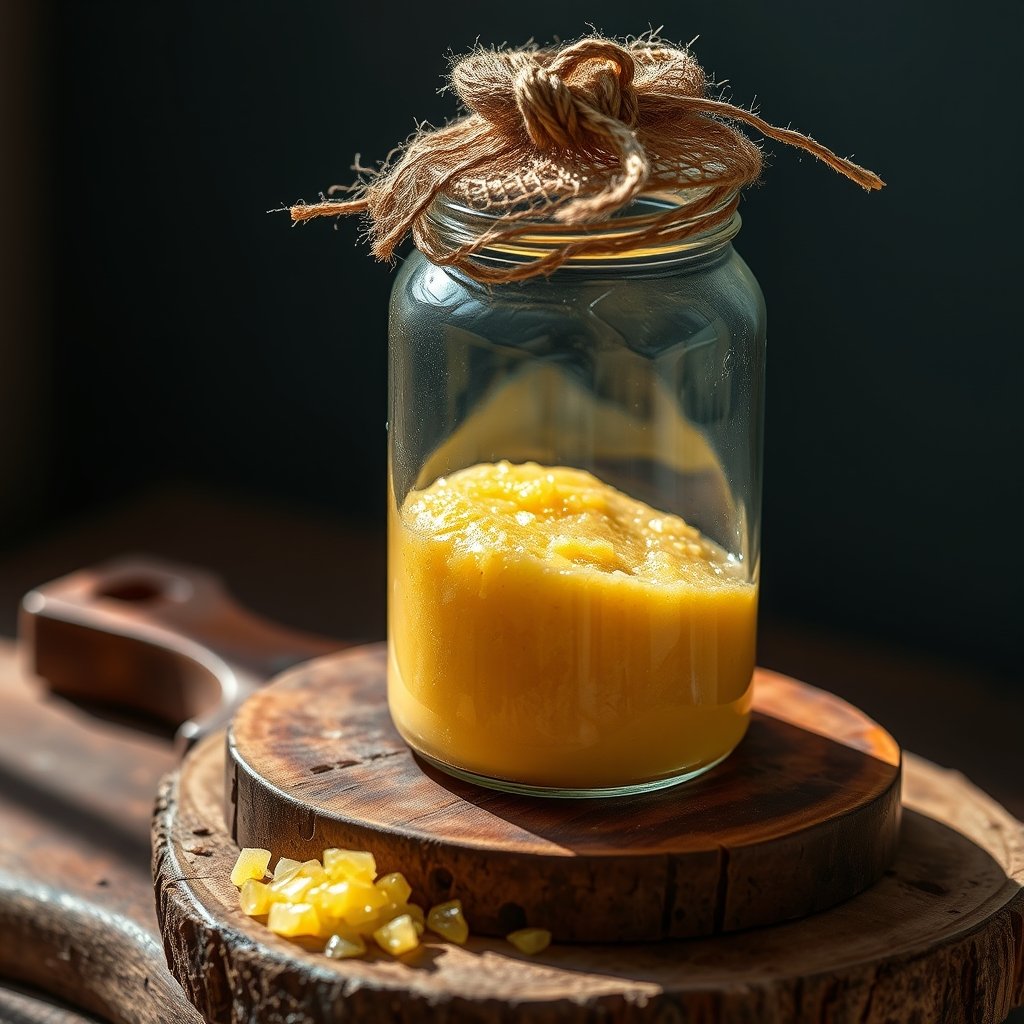
When you open a jar of genuine hand-churned A2 Gir cow ghee at room temperature, you will notice a distinct semi-solid texture filled with tiny golden grains floating in golden oil. When warmed in a hot pan for a tadka of cumin and mustard seeds, it melts cleanly without splattering excessively, filling the kitchen with an inviting, nutty fragrance reminiscent of traditional grandmother-style cooking.
Taste the difference
Small-batch A2 Gir cow ghee, hand-churned to order and delivered across India. Read how we make it if you want the detail first.
Order a jarKeep reading
-
 Reading a Ghee Label: What Each Line Actually Tells You
Understand what ghee label meaning truly involves by decoding terms like A2, bilona, and milk sources on…
Reading a Ghee Label: What Each Line Actually Tells You
Understand what ghee label meaning truly involves by decoding terms like A2, bilona, and milk sources on…
-
 How Long Does It Take to Make One Jar of Bilona Ghee?
A detailed timeline breakdown of the 24 to 36 hour traditional process required to craft a single jar of…
How Long Does It Take to Make One Jar of Bilona Ghee?
A detailed timeline breakdown of the 24 to 36 hour traditional process required to craft a single jar of…
-
 Machine vs Bilona Ghee: Spot Real Bilona by Grain Size
Real bilona ghee is identifiable by its distinct danedaar texture and nutty aroma, whereas machine-made ghee…
Machine vs Bilona Ghee: Spot Real Bilona by Grain Size
Real bilona ghee is identifiable by its distinct danedaar texture and nutty aroma, whereas machine-made ghee…
