
A Day at a Small Ghee Dairy

How does the day begin at a small ghee dairy?
Small dairy ghee making follows a slow, manual rhythm that starts with milking Gir cows in the early morning and ends with the gentle boiling of cultured butter over a wood fire. Unlike industrial operations that rely on high-speed machinery and continuous processing, a small dairy operates according to the natural cycles of the cows and the time required for fermentation. Every batch is a result of patience, often taking over 24 to 36 hours from the moment the milk is drawn to the moment the ghee is poured into a glass jar.
What happens during the early morning milking?
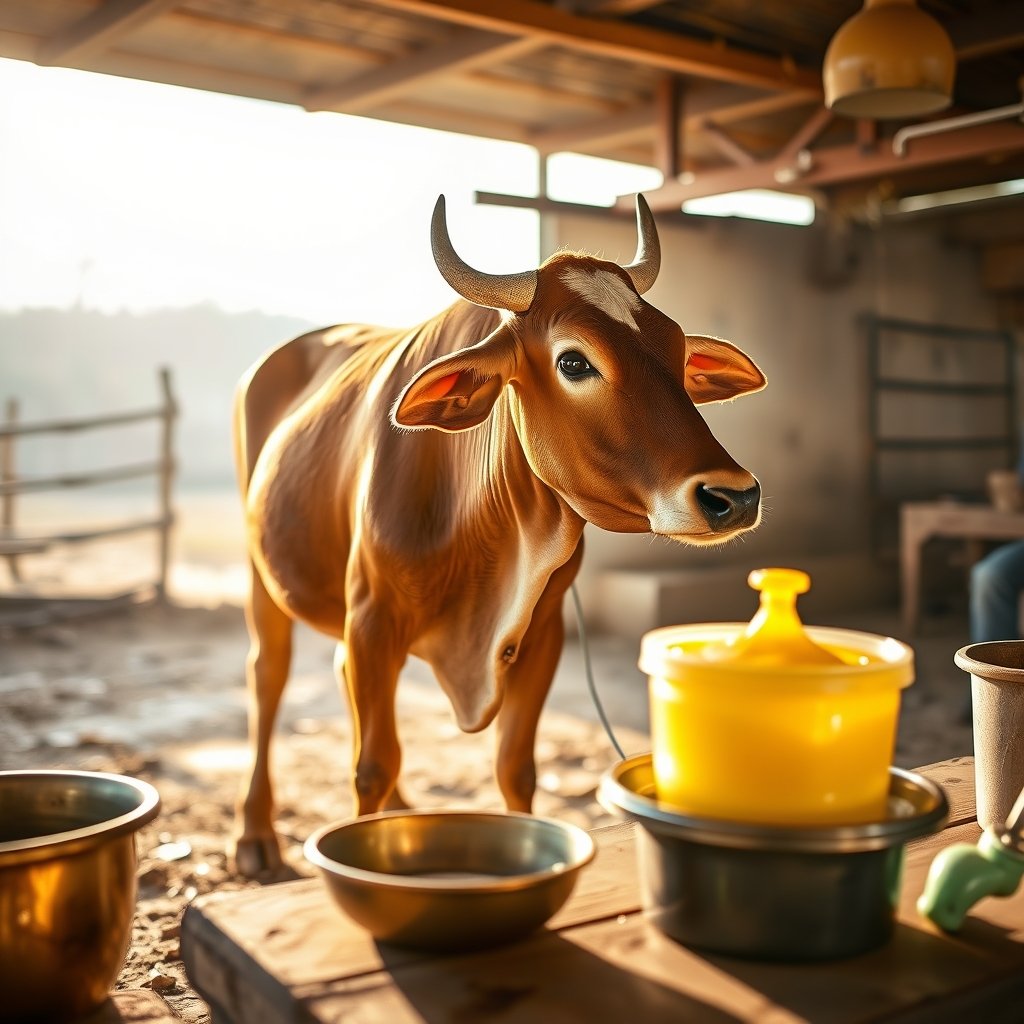
The day at a small dairy starts long before sunrise, usually around 4:00 AM. This is when the Gir cows are most relaxed. In a traditional setting, the process is not rushed. The gopalaks (cowherds) first ensure the calves are fed. This practice is not just about tradition; it is a fundamental part of maintaining a calm environment for the herd. Once the calves have had their fill, the remaining milk is collected by hand. This milk is fresh, warm, and rich in A2 beta-casein proteins, forming the base for the ghee that will be made a day later.
How is the milk prepared for the bilona process?
Once the morning milking is complete, the milk is filtered and poured into large vessels to be boiled. At a small dairy, this boiling is done slowly. The goal is to ensure the milk is safe and ready for the culture to be added. After boiling, the milk is allowed to cool down to room temperature. This is a critical waiting period. Once the temperature is just right, a small amount of previous-day curd is added as a starter. The milk then sits undisturbed for several hours, usually throughout the day and evening, turning into thick, creamy curd. This culturing process is what differentiates traditional ghee from cream-based butter, as it introduces beneficial organic acids and develops a deep flavor profile.
Why is churning done in the pre-dawn hours?
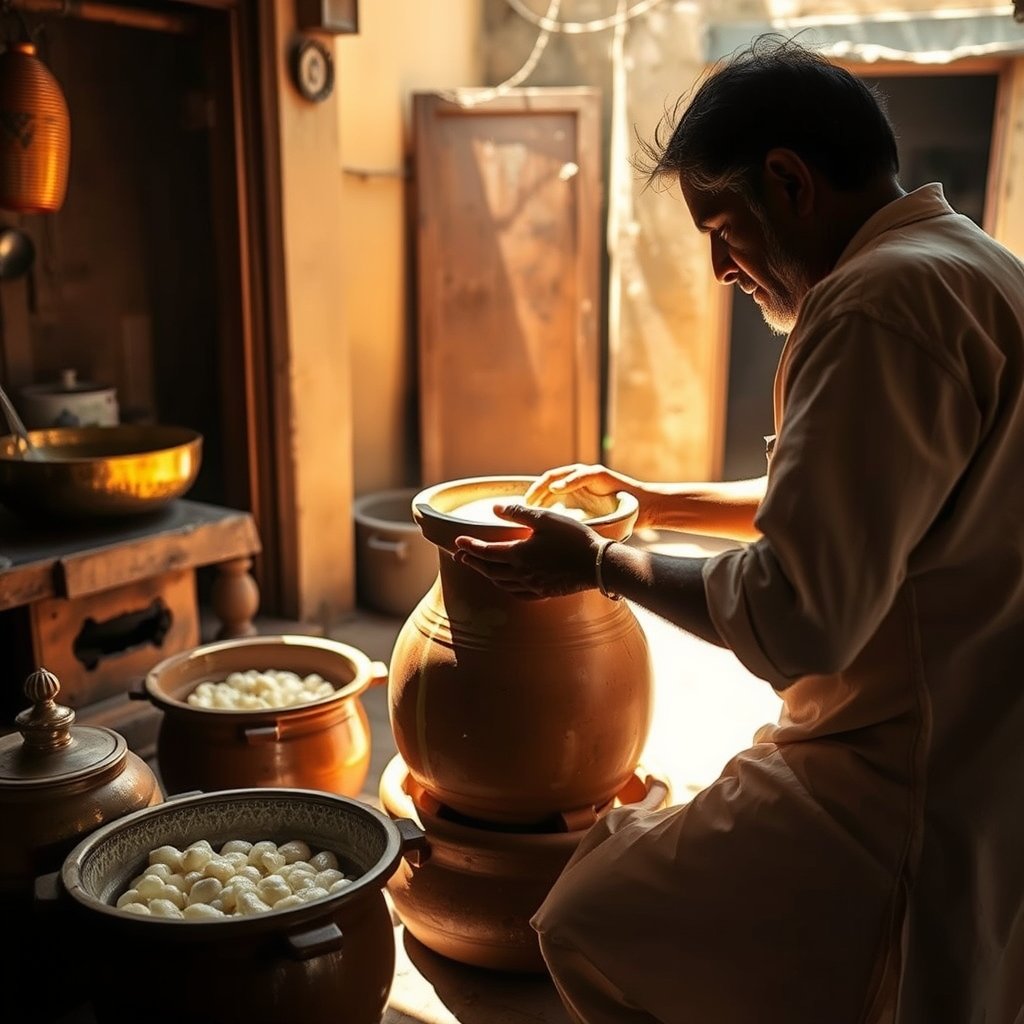
The actual bilona churning usually happens in the very early hours of the next day, often during the Brahma Muhurta (the time before sunrise). There is a practical reason for this: the temperature is naturally cooler, which helps the butter (makkhan) separate more effectively from the buttermilk. A wooden churner, or bilona, is lowered into the earthen pots filled with curd. In a small dairy, this churner moves in two directions—clockwise and anti-clockwise. This bi-directional movement is gentle on the fats, ensuring that the integrity of the butter remains intact. As the churning continues, the makkhan begins to float on top, leaving behind nutritious buttermilk.
How does small dairy ghee making compare to industrial methods?
To understand why small-batch ghee has a different texture and aroma, it helps to look at how the production steps differ from large-scale factory methods. Industrial ghee is often made to prioritize speed and volume, whereas small dairies prioritize the integrity of the traditional method.
| Feature | Small Dairy (Bilona) | Industrial Factory |
|---|---|---|
| Raw Material | Cultured curd made from whole milk | Milk cream (malai) separated by machine |
| Churning Method | Bi-directional wooden bilona | High-speed centrifugal separators |
| Heat Source | Slow wood or cow-dung fire | High-pressure steam or gas burners |
| Time Taken | 24 to 36 hours per batch | A few hours from milk to ghee |
What is the process of clarifying the butter?
After the makkhan is collected and washed, it is moved to a heavy-bottomed vessel for clarification. At Organic Farmz, we use a slow fire, often fueled by wood. This stage requires constant attention. As the butter melts, the water content begins to evaporate, and the milk solids start to settle at the bottom. You can hear a distinct crackling sound during this phase. The person overseeing the vessel watches for the moment the liquid turns a clear, golden amber and the crackling stops. This indicates that the moisture has been removed. The aroma at this stage is unmistakable—nutty, rich, and toasted. If the fire is too hot, the ghee will burn; if it is too low, the solids won't separate properly. It is a craft learned over many years.
How is the final ghee cooled and stored?
Once the ghee is ready, it is strained through a fine cloth to remove the caramelized milk solids. It is then left to cool naturally. In a small dairy, we do not use rapid cooling fans or refrigeration to speed this up. As the ghee cools slowly at room temperature, it begins to develop its characteristic grainy texture (danedaar). This granulation is a sign of well-made ghee where the different fatty acids have crystallized at their own pace. Finally, the ghee is poured into glass jars. Because every day brings slight variations in the cows' diet or the ambient humidity, no two batches are ever identical, which is the hallmark of a truly natural, handmade product.
What role does this process play in Indian home cooking?
In the context of an Indian kitchen, ghee made this way is more than just a cooking fat; it is a foundational ingredient. Ayurveda suggests that the way a food is prepared significantly affects its qualities. The slow, meditative process of small dairy ghee making is believed to retain the 'sattvic' or pure nature of the milk. When you use this ghee for a simple tadka or to top a warm roti, the depth of flavor is much more pronounced than factory-made versions. It brings a sense of the village dairy and the traditional kitchen into the modern home, connecting today’s meals with ancient culinary wisdom.
Taste the difference
Small-batch A2 Gir cow ghee, hand-churned to order and delivered across India. Read how we make it if you want the detail first.
Order a jarKeep reading
-
 What Makes Gir Cows Different From Crossbred Dairy Cattle
Explore the anatomical, genetic, and milk profile differences between Gir cows and crossbred cattle, and why…
What Makes Gir Cows Different From Crossbred Dairy Cattle
Explore the anatomical, genetic, and milk profile differences between Gir cows and crossbred cattle, and why…
-
 Why We Let Calves Drink First
Discover why allowing the calf to feed first is the cornerstone of ethical A2 dairy. Learn how this…
Why We Let Calves Drink First
Discover why allowing the calf to feed first is the cornerstone of ethical A2 dairy. Learn how this…
-
 Why Local Small-Batch Ghee Beats Supermarket Brands on Freshness
Discover why small-batch bilona ghee offers a superior aroma and texture compared to mass-produced…
Why Local Small-Batch Ghee Beats Supermarket Brands on Freshness
Discover why small-batch bilona ghee offers a superior aroma and texture compared to mass-produced…