
Ghee Export from India: Key Buyer Questions Answered

When importing ghee from India, overseas buyers focus primarily on authentic bilona sourcing, tamper-evident retail packaging, label compliance, and clear documentation suited to their destination country's import regulations. An international buyer looking to source premium fat from India needs to evaluate how the ghee is crafted, how it survives ocean or air freight, and how local food standards govern import clearance. Because every destination country enforces distinct dairy importation laws, labeling mandatory disclosures, and customs protocols, navigating these questions early determines whether an export venture succeeds or stalls at port customs.
What process details do foreign ghee buyers request first?
Foreign buyers consistently ask for proof that the product is authentic A2 Gir cow ghee made using the traditional bilona method rather than high-heat industrial cream separation. They want to verify that fresh curd made from whole A2 Gir cow milk is bi-directionally hand-churned into makhan before being slowly clarified over a gentle flame. Buyers inquire about batch consistency, natural aroma, coarse granular texture, and milk sourcing practices near Delhi. Explaining the step-by-step traditional method reassures overseas distributors that the ghee will retain its rich taste and characteristic golden color without relying on synthetic additives, artificial flavorings, or chemical processing.
How is packaging handled for long-distance transport?
Overseas buyers require shelf-stable packaging that prevents oxidation, handles transit vibration, and arrives completely leak-proof at the final destination. Exporting fat across international shipping lanes presents distinct climate and structural risks, as jars undergo significant temperature fluctuations and prolonged transit times. Buyers must decide whether to receive bulk ghee for local repacking abroad or import fully finished, individual retail glass jars that are sealed and ready for store shelves.
Comparing these two supply formats reveals distinct operational trade-offs for international importers:
| Packaging Format | Transit & Handling Risk | Regulatory Readiness |
|---|---|---|
| Bulk Containers (Unlabelled) | Requires secondary repacking facility overseas; higher risk of contamination during transfer. | Requires local filling licenses, fresh batch coding, and additional regulatory inspections abroad. |
| Sealed Glass Jars (Ready-to-Ship) | Protected by tamper-evident caps and heavy glass; zero exposure to air after leaving production. | Pre-labelled with complete compliance details, batch numbers, and direct shelf readiness. |
Our cows are not use and throw

A cow that stops giving milk is still our cow. She stays on the farm, with the same feed, the same shed and the same medical care she had when she was milking. We do not sell her on and we do not let her go. That is the whole basis of the ghee we make — you cannot ask an animal for her milk and then abandon her for it.
Our mission goes further than our own herd. There are cows on the street who are injured every day, who eat plastic, who cry through the night with nobody coming. We want to take them in. The plan is a chain of Organic Farmz gaushalas in several places, so that help is not one shed in one city but something a hurt animal can actually reach.
This takes more than we can carry alone — land, fodder, vets, hands. Come and join our initiative. Anything you give goes to feed, treat and shelter these cows.

Scan with any UPI app
Bank transfer
- Account name Organic Farmz
- Bank Indian Bank
- Account number 8133177322
- IFSC code IDIB000K555
- UPI ID organicfarmz@ptaxis
On a phone, the button above opens your UPI app directly — a QR on the screen you are reading cannot be scanned by that same screen. On a laptop, scan the code with your phone instead.
Who manages label artwork and regulatory compliance?
The brand owner purchasing the ghee retains full responsibility for compliance with their target market's food safety authorities, while the production partner executes the printing and application according to exact artwork specifications. International buyers must provide print-ready artwork that includes their own regulatory registration numbers, mandatory ingredient declarations, net volume, country-of-origin statements, and nutritional panels formatted for their local jurisdiction. The Indian production partner ensures that the physical jars are filled, hermetically sealed, code-stamped with batch identifiers, and labelled precisely as designed so that the buyer never has to unseal or repack the product upon arrival.
How are import documentation and shelf life determined?
Import documentation, testing requirements, and designated shelf-life statements are strictly governed by the destination country's food control agencies rather than set unilaterally by the maker. Overseas customs officials may request specific laboratory certificates, origin declarations, or dairy transport permits depending on local import categories. Shelf life and storage guidelines depend heavily on the climate conditions, humidity levels, and import policies of the receiving country. Every international market sets its own mandatory testing parameters and documentation requirements, which must be clarified between the buyer and their local customs broker prior to dispatching a shipment.
What is the step-by-step process to launch a private-label export?
Launching a private-label export begins with a direct structured inquiry and rigorous sample testing before any formal manufacturing commitment is made. At Organic Farmz, we make pure A2 Gir cow ghee using the traditional bilona method near Delhi and prepare custom-branded orders through a clear, transparent partnership process:
1. Initial Contact: The buyer sends an inquiry via email or WhatsApp outlining their brand name, preferred jar capacity, estimated monthly volume, and expected launch date.
2. Sample Evaluation: A dedicated sample batch is dispatched so the buyer can inspect the color, grain, aroma, and consistency firsthand before proceeding.
3. Formal Agreement: A written contract is established covering unit rates, order volumes, container specifications, artwork ownership, and agreed protocols for handling any batch disputes. Minimum order quantities, custom pricing structure, and manufacturing lead times are negotiated individually during this stage and depend on specific order parameters.
4. Artwork Submission: The buyer provides finalized artwork files containing their business details, local FSSAI number or foreign equivalent, and required legal disclosures.
5. Production & Delivery: The ghee is crafted to order, filled into heavy glass jars, hermetically sealed, batch-stamped, labelled, and packed into master cartons ready for shipment, eliminating any need for repacking by the buyer.
To start your export brand journey with custom bilona batches, explore our white-label partnership page to submit your inquiry and request your first sample jar.
Taste the difference
Small-batch A2 Gir cow ghee, hand-churned to order and delivered across India. Read how we make it if you want the detail first.
Order a jarKeep reading
-
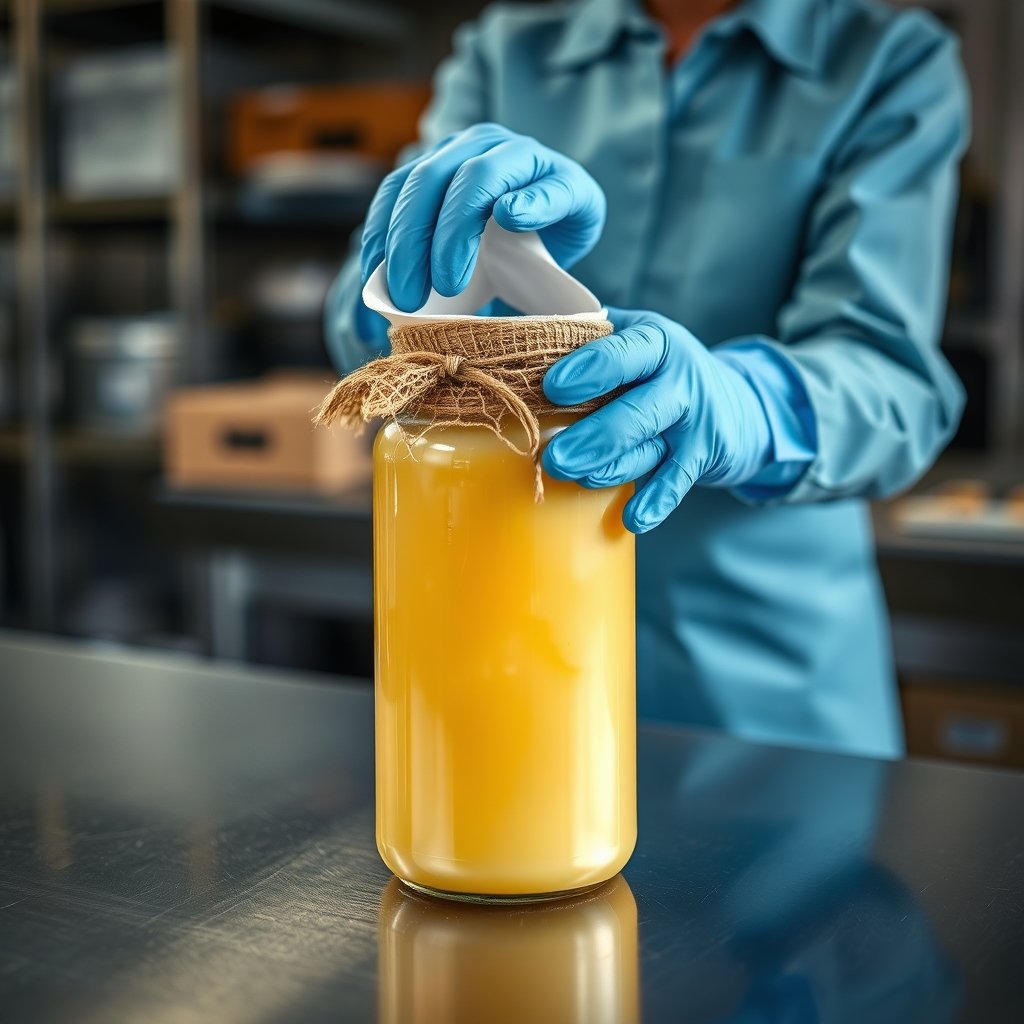 Custom Branded Ghee Jars: Yes, with Your Own Artwork
You can put your brand name on a ghee jar by submitting artwork and your FSSAI number. Fresh A2 bilona ghee…
-
 D2C Ghee Brand India: The Work Is Front of House
Launching a D2C ghee brand in India succeeds or fails on customer service, packaging, and brand reach rather…
-
 White-Label Ghee Agreement: 7 Essential Clauses
A white-label ghee agreement must define rates, batch volume, artwork rights, glass jar specs, quality…
